Connact Networks · Platform
The Connact Community EngineA substantial foundation, shaped into your institutional product.
Not a blank-sheet build. Not a white-label subscription. Twelve modules that already exist, each described by exactly what state it is in. A claim about a platform deserves the same honesty as a claim inside one.
The record
The differentiation. Everything else in this list exists on other platforms; this layer is why an institution would choose Connact over them.
Provenance
Nothing enters without who says so attached. Four tiers render distinctly, and a platform computation is never dressed up as a credential.
Implemented foundationNotary
Signed and appended from record #1. The rule against rewriting history is enforced in the code itself, not in a setting an administrator could change. Root hashes mirror to an append-only public witness, pointed at your own repository at deployment.
Implemented foundationVerify
A permanent address per claim that resolves on its own, independently of every other service. Works the same for a browser and for a machine fetching JSON.
Implemented foundationAttestation
Human witnessing with a stated relationship and two-sided consent. The witness’s identity travels with the claim. Never a counter.
Implemented foundationThis comparison is too lopsided to draw to scale. At the scale of the bar above, where 7 days spans the full width, the request below would be about a fiftieth of a pixel. It is drawn at a readable minimum instead, so read the second bar as a marker rather than as a measurement. The ratio is calculated from the two figures shown: 7 days against 1.2 seconds.
Identity
One typed record per subject, with one permanent URL. It renders wherever it is useful, and it is disclosed only as far as the holder allows.
Subjects
People, organisations, works and objects as typed records. Written once, rendered on the member’s page, your public site, search and partner surfaces.
Implemented foundationDisclosure
Set per item by the holder: public, link-only, or on-request. It is never sold as a paid upgrade and never traded.
Implemented foundationAccount ownership
Proving a member actually controls the handles, domains and profiles they claim. Worth more every year that identity forgery gets cheaper.
Demonstrable capabilityDirectory and discovery
People, organisations, expertise and topics, searchable and ranked by relevance and standing rather than by engagement.
Demonstrable capabilityThe institution
What your operators run day to day, and what your members experience as membership.
Collections and spaces
Containers with an access policy: open, approval-based, restricted or private. Membership is a dated assertion with validity, not just a row in a table.
Implemented foundationCredentials
Issuer, holder, verifier. Offered credentials require acceptance; expiry, revocation and verification pages are first-class.
Implemented foundationProgrammes
Contextual submissions with attached evidence, review pathways and outcomes that become credentials or opportunities.
Configurable client deliveryOperations console
Roster import with dry run, claim queues, issuance, access, moderation, publishing controls and an audit trail kept separate from the signed record.
Demonstrable capabilityThe agent gateway
What makes this a 2026 platform rather than a 2019 one. Possible here only because consent and disclosure were modelled as first-class concepts from the start.
Delegated grants
A member can authorise an agent to act for them, on named records only, until a stated date. The grant is revocable at any time and comes with a receipt the member can read.
Integration-ready architectureGoverned retrieval
Retrieval over institutional knowledge that checks disclosure at the moment of the query, per item and per person, instead of after the answer is already given.
Integration-ready architectureCited answers
Machine output that resolves to provenance-bearing records with verify links attached, rather than a fluent summary nobody can check.
Optional moduleIntegration surface
OpenAPI contracts, OAuth 2.0 and OIDC, webhooks, a TypeScript SDK, and full data export at no cost, always.
Integration-ready architectureGrants a scope
Names the agent, the specific records it may read, and the date access ends. Nothing is granted by default.
Issues a receipt
The grant is signed and written to the member’s own history, readable by them, in plain language, at any time.
Acts within it
Presents the grant. Records outside the scope do not resolve. They are not filtered out afterwards; they never load in the first place.
Receives a signed answer
Structured JSON carrying only the disclosed records, plus a count of what was withheld. Verifiable without calling us.
Access stops on the stated date. No renewal is implied and none happens silently.
The member revokes and access ends at the next request. No notice period, no appeal, no support ticket.
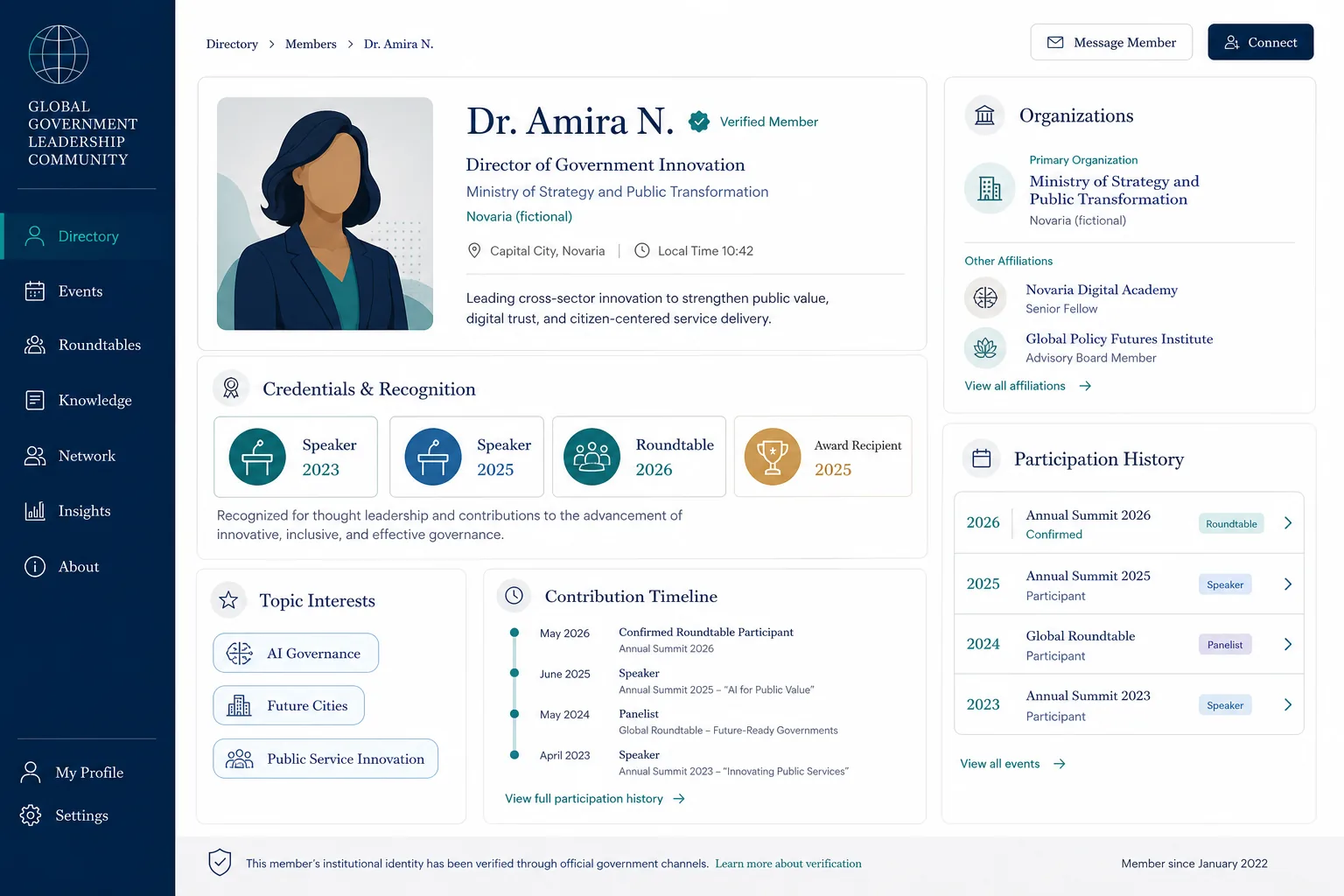
What twelve modules look like on a single member.
Identity, credentials, affiliations, topics and a dated contribution history are separate modules above. A member never sees them as separate.
Work out which of these your institution actually needs.
Every module above carries the state it is genuinely in, because a list of capabilities is easy to write and hard to check. Which of them matter to you, and in what order, is the question discovery answers.